Emeritus Professor George Yeoh was on holiday with his wife Val, cruising down the Volga from Moscow to St Petersburg, when he had a chance meeting with another passenger who would contribute enormously to the scientist’s cutting-edge stem cell research.
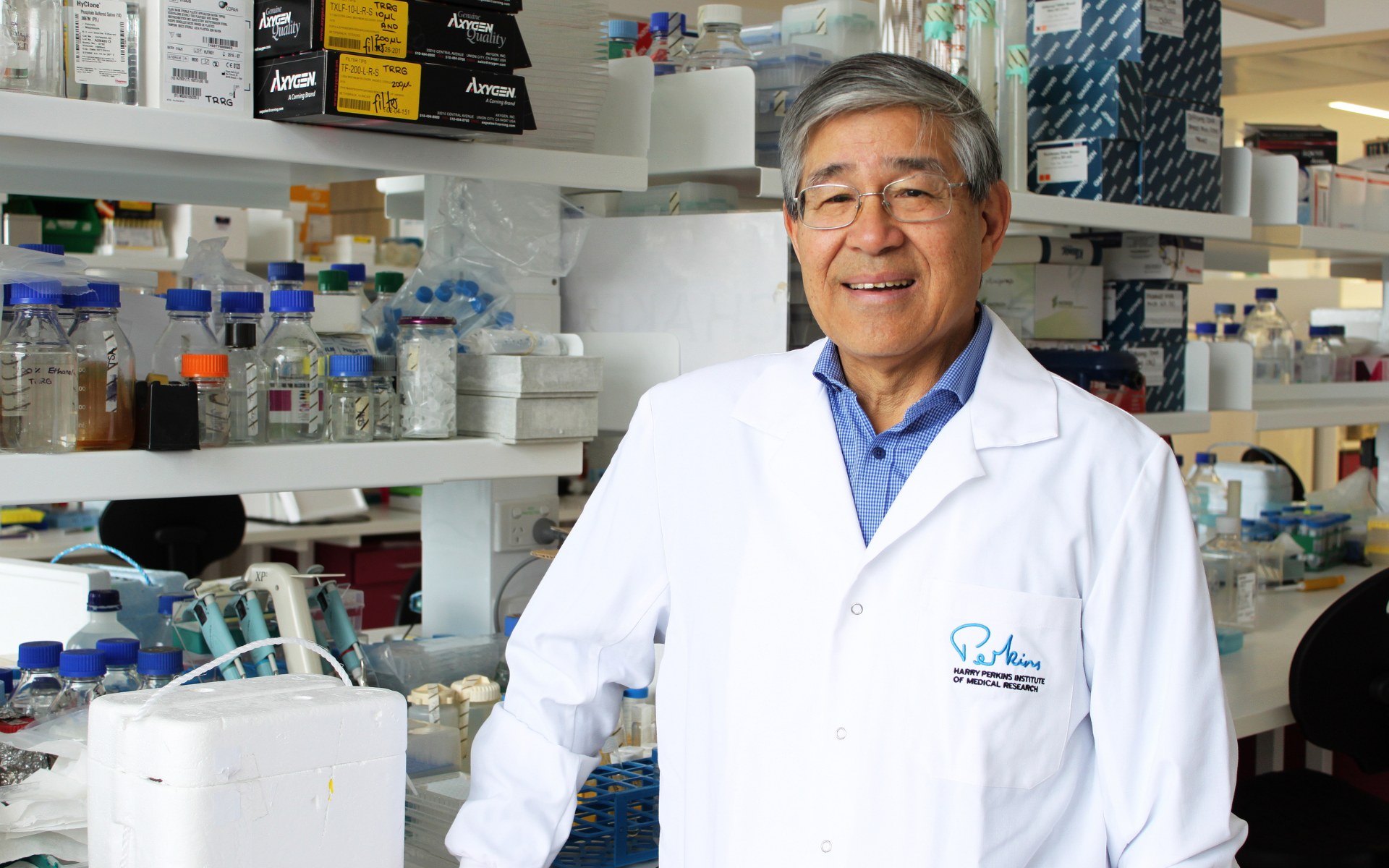
Prof George Yeoh in the lab at the Perkins.
“They were mostly Aussies on the trip,” Prof Yeoh recalls. “Somebody came and tapped me on the shoulder and said, ‘Hey, you’re a stem cell researcher, aren’t you?’. I said, ‘My God. How do you know that?’.
“He said, ‘Oh, you’ve got a backpack that says you’ve been to the International Stem Cell Society meeting! So, if you’re a stem cell researcher, I’ve been asking, is there any way I can help you guys, because stem cells saved my life. I developed leukemia, and I was cured by stem cell therapy.’
“They’d given him intense chemo and radiotherapy. They wiped out virtually all the cells in his body and gave him new bone marrow stem cells. Those cells repopulated his body. And the cancer did not return.
“I said to him, ‘What is the basis of your leukemia?’ and he said, ‘I’m TP53 deficient. I’m a Li-Fraumeni patient’. I said, ‘I’ve made stem cells from a mouse that’s like you! Can I have your cells?’. He said, ‘Sure, if that’s a way I can give back’.
“So, Alan Hill donated his cells, and we have made stem cells from him.”
However, George Yeoh’s journey from a teenager growing up in Kuala Lumpur to internationally lauded liver cancer researcher hasn’t always been plain sailing.
In 1960, his mother decided young George and his brother should be educated in Australia and become doctors, so she committed one-third of the family’s wealth towards this endeavour.
The next year George and his brother travelled from KL to Singapore and boarded the merchant vessel, the Charon, for the five-day journey to WA.
As he told a packed auditorium last year, when delivering the 2025 Wesfarmers Harry Perkins Oration: “I got awfully seasick when we reached Shark Bay, and then we arrived in Fremantle and two Marist brothers picked us up and took us directly to New Norcia.”
He spent the first school term at St Ildephonsus’ College in New Norcia. For his first Easter in WA, he was taken in by a host family.
“My Easter would have been very lonely if it hadn’t been for the Clune family,” he said. “This kind of generosity really astounded me. People asking you, a foreigner, to come into their home. Mr Clune took me crabbing. My English was very poor, but when a crab bit Mr Clune, I heard a lot of English words I’d never heard before. When I went back to St Ildephonsus, and I repeated those, I got the bat treatment: a cricket bat meeting your bottom for saying bad words.”
In term two, young George transferred to Guildford Grammar School, where he says he learnt the value of science and had his first introduction to microscopes. He also developed a lifelong love of tennis.
After graduation, he did a Bachelor of Science at UWA and then received his PhD in Biochemistry in 1972.
“My PhD supervisor introduced me to the liver and I was smitten,” he said in his Oration at the Perkins. “And then the head of Physiology was my postdoctoral mentor and he was very instrumental in my research skilling. He taught me how to do research in a rigorous way, what were the controls, how you design experiments, how you have to keep up with the literature.”
To pursue his research into the liver, he needed to learn cell culture – then in its infancy. Through a CJ Martin Fellowship from the NHMRC, he was able to spend time working with two experts, the University of Pennsylvania’s Howard Holtzer, who coined the term “quantal cell cycles”, and John Paul, head of the Beatson Institute cancer research centre in Glasgow, who wrote the research “Bible”, Cell and Tissue Culture.
Back in Perth, as an NHMRC Fellow, Prof Yeoh now had the tools to study how the liver actually develops.
“My idea was, now I know how to culture these cells, take these livers at different stages of development, put them into a culture medium, and see what they do. If they do different things, then it’s because they are inherently different, as the environment is the same,” he said.
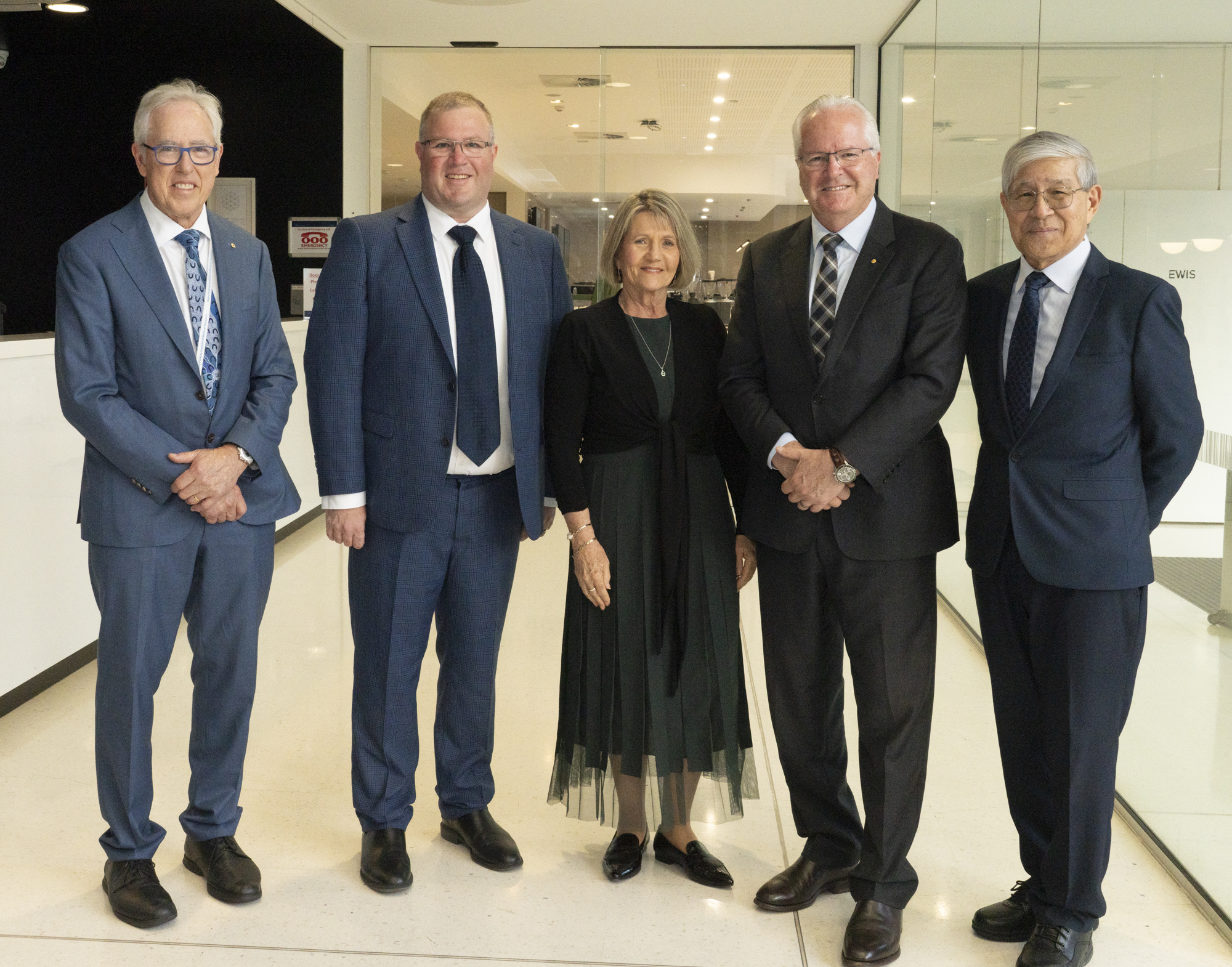
On the night of the Perkins Oration: Perkins CEO Professor Peter Leedman, Perkins Chair Ben Morton, Mrs Darrilyn Dawson, Governor Chris Dawson, and Prof Yeoh.
In his Oration, he explained that the liver, a powerful regenerating organ, repairs damage by two methods: proliferative cell cycles, or quantal cell cycles.
In Method A, where a person has acute liver damage, the hepatocytes simply divide to boost their numbers.
In Method B, where a person has chronic liver damage, stem cells start proliferating in a different fashion, producing hepatocytes, cholangiocytes, or more stem cells.
In 1998, Prof Yeoh was invited to join the West Australian Institute of Medical Research, later the Perkins, to advance his research into liver stem cells. He is now the leader of the Liver Disease Carcinogenesis Lab at the Perkins.
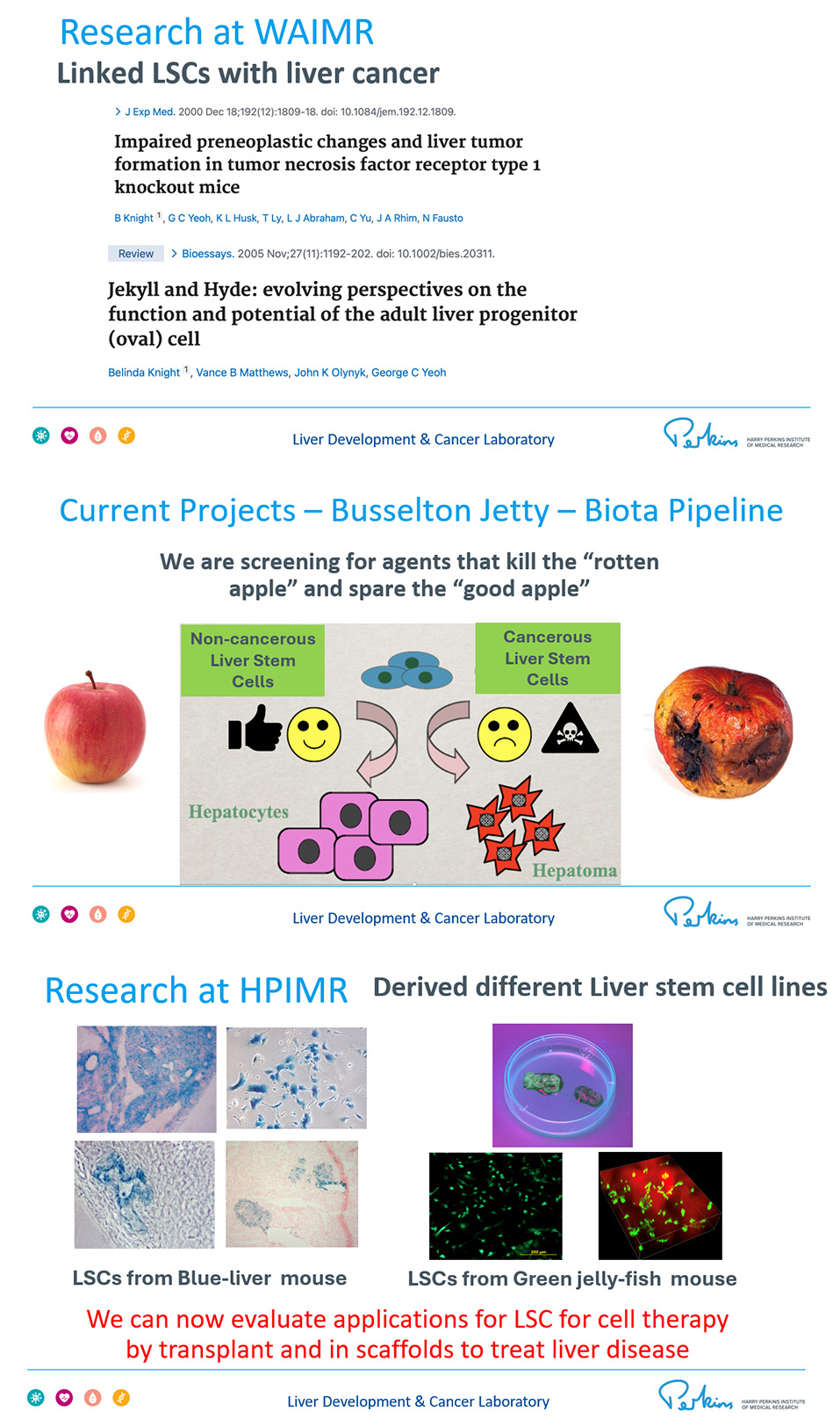
“The most important thing that we achieved here, which we sent all over the world, is a liver stem cell isolated from the fatty liver mouse model we developed,” he told the Oration audience. “They have fatty liver disease, and then they produce these liver stem cells called oval cells. If you give them this diet long enough and insult the liver frequently and over an extended period, the mice develop liver cancer. Here was the first link between these stem cells and liver cancer.”
After further research, Prof Yeoh determined that these oval cells, which also proliferate in human chronic liver disease, had a Jekyll and Hyde character.
“They could be good and they could be bad,” he tells Medicus.
“I think if you poke the bear, you drink heavily, consistently for long enough, then you are stressing your stem cells. Another theory of mine is when you take a stem cell and divide it, and you take a somatic cell (the hepatocyte), and divide it the same number of times, I’m convinced that the stem cell will accumulate more mutations.
“A corollary is that the stem cell doesn’t protect its DNA as well when it’s replicating because it is plastic, whereas the somatic cell, like the hepatocyte, is already set and H gives rise to 2H. If stem cell SC gives rise to H, that division gives you a new repertoire of genes that you can express. And for that reason, somehow, chromatin, the DNA, is more susceptible to mutations. So that’s a hypothesis that’s on my bucket list.
“If you sunbathe, UV mutates your skin cells but they die and are lost. The endodermis produces more skin cells. The cells in the crypt give rise to the cells in the villus of the gut. If you have issues of turnover, increased cell turnover if there is trauma, this stresses the stem cells. That’s what happens with age. We have more turnover of our stem cells as we age, and so that is the Hyde part of the stem cell that we have to recognise is there.
“I have a model that simulates that in culture. I take my liver stem cells and I just passage them. The more I grow them, the more likely they’re going to give rise to cancerous cells when transplanted into an immune-deficient mouse and produce a liver tumour.
“So you damage your liver, it grows back. But if you do that repeatedly and as you get older, your hepatocytes age and they’re not as robust, they don’t grow so easily, then Method B kicks in.”
Prof Yeoh believes that single-cell analysis, using a very sophisticated piece of equipment at Perkins, can identify the Jekyll and Hyde stem cells.
“Another thing I’d love to do is to know the difference between Jekyll and Hyde,” he says.
“I believe that with single-cell technology, we could find a lot of Jekyll and Hydes induced in a liver, be it in a human or in a mouse liver. And then we sequence their DNA, and there will be more mutations in Hyde, and Jekyll will be normal.
“More importantly, if I take Jekyll and divide it, I should get hepatocytes. If I take Hyde and divide it, I should get a hepatoma. It would be beautiful if I could do this. And it can be done, but it requires about a million bucks worth of reagents to do all the single-cell stuff on liver biopsies.”
But Prof Yeoh says there’s also another possible scenario about how the Hyde cell appears.
“Let’s say initially all your cells are good ones, right? Now, in a human or in my culture, what is happening?” he asks. “Do we have a few bad guys already? And all we’re doing when we passage is letting the bad guy win the race because cancer cells divide more rapidly. With each passage, are we increasing the percentage of Hydes, the bad guys? Or in the passaging, do mutations accumulate and suddenly Hyde comes up? You see, that’s a very important difference.