



Homegrown preterm program makes ‘Every Week Count’

It was late one night last year when John Newnham, Professor of Obstetrics at the University of WA, joined a meeting on Zoom to discuss preterm births. No surprise there, as he’s one of the world’s leading authorities on the subject. But this wasn’t a normal Zoom session with colleagues in Australia or elsewhere. On the call from the UK were three Lords (including Robert Winston, of IVF fame), six Baronesses and one Viscount, all members of a House of Lords committee investigating why England’s premature birth rate wasn’t falling, and they wanted to know from Prof Newnham and two other European experts, from Sweden and The Netherlands, what they might do about it. It was nearly midnight in Perth when the session ended.
“The House of Lords Preterm Birth Committee was asked to investigate why preterm birth rates in England were not falling despite new discoveries, and they found out about the Australian story and asked me to present on our national program,” Prof Newnham recalls.
“They were very esteemed people interviewing me, very esteemed, including Lord Winston, and I think one of the Baronesses had been minister for health in the UK.
“Anyway, they said to me: ‘We understand what it is, we’re going to give you plenty of time, just speak and we won’t interrupt you’. I think I probably spoke for about 20 minutes, and the baroness said at the end, ‘Yes, that’s totally clear, we understand, thank you very much’.
“I think you’ll find that people will be copying our program.”
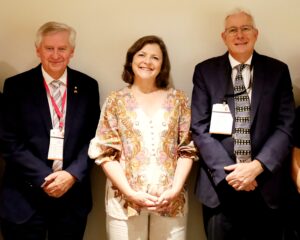
Australian Preterm Birth Prevention Alliance Chair Prof John Newnham, former Assistant Minister for Health Ged Kearney, and President of Women’s Healthcare Australasia (WHA), Prof Jonathan Morris.
That program, the ‘Every Week Counts’ National Preterm Birth Prevention Collaboration, was boosted in February when the Federal Government said it would provide an additional $5.3 million in funding to improve pregnancy outcomes for more women across the country.
The national program, which has prevented more than 4,000 untimely early births, continues to be led out of King Edward Memorial Hospital by Prof Newnham AM, who is also chair of the Australian Preterm Birth Prevention Alliance.
The ‘proof of concept’ phase for the program, a pioneering initiative in WA that led to an 8% drop in premature births in the State, ran from 2014 to 2018. The Australian Preterm Birth Prevention Alliance was created in 2018, and then in 2021 the Federal Government approved a $13.7 million budget to fund the world’s first national scheme.
There were 59 major hospitals in the first phase of the ‘Every Week Counts’ Collaborative program, representing 64% of Australian public births, and the rate of premature birth was reduced by about 10%.
“What we’re doing in the next phase is that we’re holding the gains, amplifying the story, and adding something new,” Prof Newnham explains.
“We’re running another Collaborative. This will probably be 40 hospitals, and one-third of the hospitals have previously been enrolled, so we’re holding the gains in them, and two-thirds are new, so we will be hoping to get up to 80-90% of all Australia’s public births by the next round, and we’re aiming to lower the preterm and early term birth rates.”
King Edward Memorial Hospital will be participating in round 2 of the national program, along with Fiona Stanley, Osborne Park, Armadale, Bunbury, Rockingham, SJOG Midland and Bentley.
Prof Newnham says a strong focus in this next phase of the ‘Every Week Counts’ program will be on preterm pre-eclampsia, which causes 10-20% of early preterm births.
“The thing that’s actually consuming most of my time is we’re charged with evaluating how preterm pre-eclampsia screening can be effectively rolled out in Australia,” he says.
“The science is very clearly worked out: low-dose aspirin started before 16 weeks, if given to the right women, will prevent at least 65% of preterm pre-eclampsia.
“We’ve got to work out who to give it to. There are side-effects, though they’re very rare, but you can’t give it to everybody.
“There’s a screening program worked up in London, scientifically proven to work, but implementing it is not straightforward.
“There are four components to the screening program and you enter the data into an algorithm. First of all, history. Secondly, you’ve got to take the blood pressure, but in a special way. Thirdly, you do an ultrasound between 11 and 14 weeks of the uterine artery and you do a measurement in it. It’s simple once you know how to do it, any imaging provider can do it, but it’s got to be done. Then fourthly, a blood test.
“Now, you don’t need all four. You need the first two. If you’ve got all four, it’ll predict somewhere between 80-90% of preterm pre-eclampsia. If you’ve only got history and blood pressure, it’s somewhere between 50-60%.
“So we’ve got to work out how to implement that in GP practices and regional hospitals across Australia, and then we’ve got to recommend to the Commonwealth Department of Health by mid next year how this should be appropriately implemented: what changes do there need to be with the billing structure, pathology structure, imaging billings, to make it so that every Australian woman is offered this in early pregnancy.”