




Repeat miscarriages prompt research study

Miscarriage isn’t something that you often hear people talking about, so a Perth Fringe Festival show called ‘What to expect when you’re no longer expecting’ was an obvious drawcard for Professor Gina Ravenscroft, who is investigating the issue.
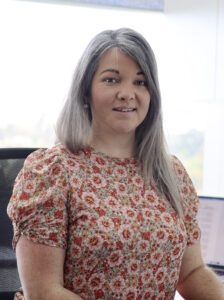
Professor Gina Ravenscroft in her office.
“It’s a bit of a taboo subject,” Prof Ravenscroft says, “but this isn’t a rare condition. Many couples experience recurrent pregnancy loss.
“Samantha Payne, who established the Pink Elephants Network (to support people experiencing pregnancy loss), was saying we just don’t capture the data. You know, pregnancies are lost before a certain period, and it’s not even recorded anywhere. We don’t actually know the numbers. It’s sort of a big black hole of what the numbers are.”
As part of a five-year, almost $5 million Medical Research Future Fund grant, the Perkins researcher is leading the study to identify why some women have repeated miscarriages.
The study team is looking for 100 couples of reproductive age from WA who have had two or more unexplained miscarriages to provide a blood sample for genetic testing.
The research study is using a hi-tech tool called Optical Genome Mapping (OGM), an imaging technology that relies on an extraction protocol to produce fragments of ultra-high molecular weight DNA that are then loaded on silicon chips, where the DNA is essentially converted into a barcode.
“You load that chip into a machine, the Saphyr instrument, which is essentially a fluorescent microscope, and it takes lots and lots of images of these long DNA molecules,” Prof Ravenscroft explains.
“Because these molecules or fragments are so large, it can map these back to the reference genome, and you make a map of the genome from these bar-coded fragments of DNA; and because of this technology you can then find all different types of structural variants, which with traditional sequencing technology are more difficult to identify.
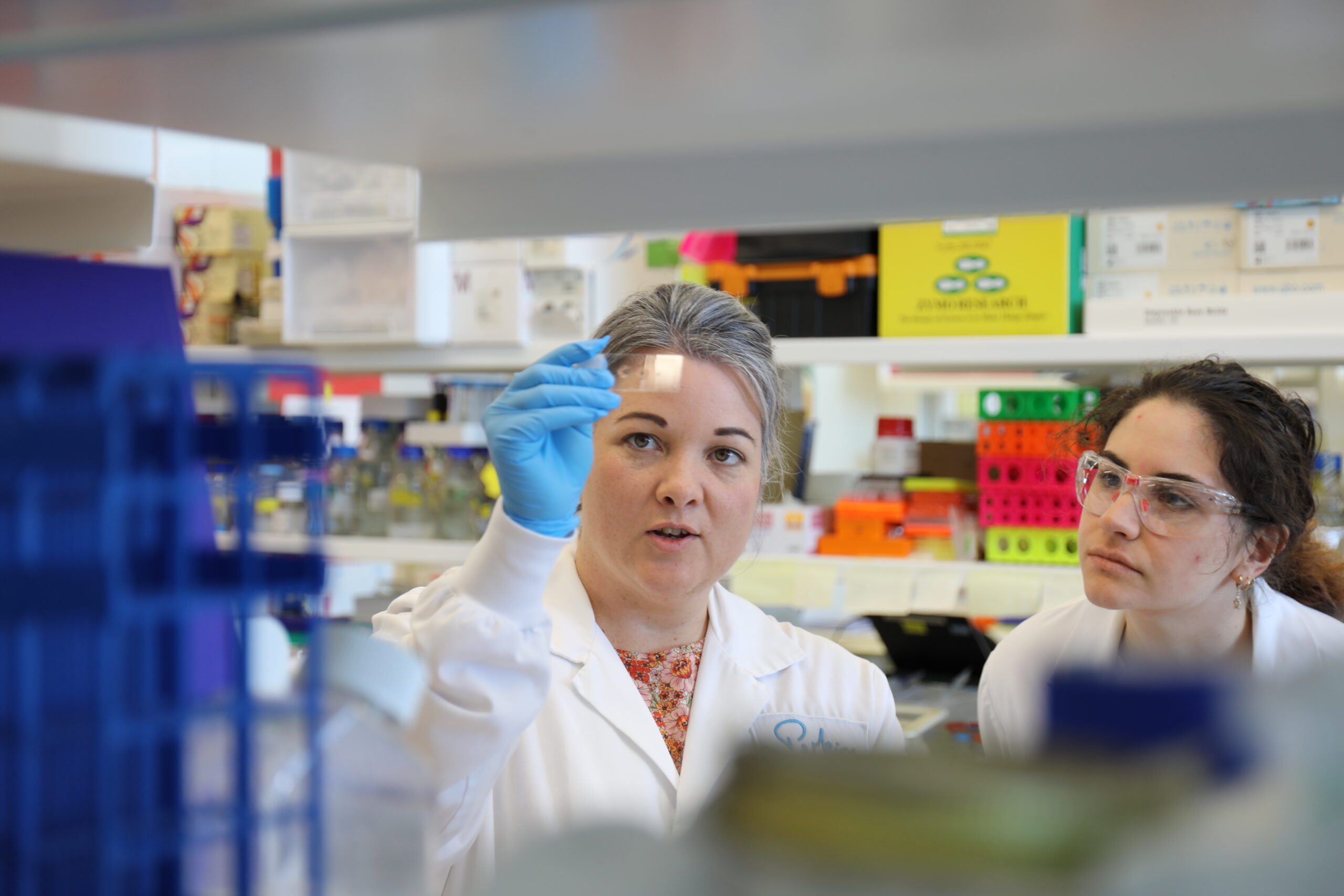
Professor Gina Ravenscroft in the lab with PhD student Chiara Folland.
“So, we can find things where bits of chromosomes aren’t in the right place, where there’s been translocations and a bit of a chromosome is on another bit of a chromosome. We can find big deletions, big inversions, where the DNA sequence is in the opposite orientation to how it should be, and we think that many of these structural variants may underlie pregnancy loss, so we’re hoping this technology will help us find those.”
Prof Ravenscroft said a group in Hong Kong had been looking for a few years for structural variants in the setting of recurrent pregnancy loss. Using a different technology, they found a genetic cause for pregnancy loss in 12% of couples they tested.
“That’s why we started with 100 couples because we think if we’re going to see something in at least 10%, then we need 100 to find enough things,” she says. “If we did too few, we might not find anything. We’re trying to work out what the sweet spot is and because this is a different approach, we really don’t know what the yield, what the percentage of genetic diagnoses, might be in our setting.
To find out more, contact Prof Ravenscroft at gina.ravenscroft@uwa.edu.au.