



Mind on the job

Claim EA: Professional Reading CPD hours with AMA CPD Home. Learn more in our helpful article and log your hours.

At 38 years old, psychiatrist Dr Kyle Hoath is the AMA (WA)’s youngest ever president. Writer Martin Saxon explains how he got here.

Kyle Hoath says it’s time to stop talking “like a broken record” about the problems in our health system and start taking action to solve them. As he rightly points out, record ambulance ramping at hospitals, that prompted a front page all-caps “EMERGENCY” headline in The West Australian, is really not news to anyone.

“It does feel like a broken record,” the new AMA (WA) president says. “My predecessors have been talking about ramping for years. It’s my first time, but I must have said it 7,000 times in a 24-hour window!

“That’s a problem because it means we’re not addressing the issues that are causing it. It continues to be a bigger and bigger problem, despite the initiatives the department and government have put in place. 
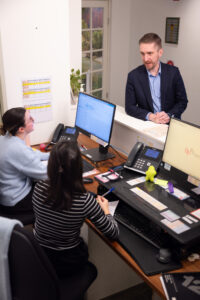
“Ramping is a hard one. It’s an expensive problem to fix, but the money’s worth spending. I do believe they need to spend more, and in WA we’re in a privileged position with our resource sector to be able to do that. If they consider that unaffordable, at what point do we say, ‘Enough is enough’? I think we’re past that point. It’s been my argument that this is no longer negotiable. We need investment in our health system to deliver a bare minimum of care now – not the world-class care we say we want to provide. We do provide world-class care, but people just can’t access it.”

Premier Roger Cook’s own website (rogercook.com.au) boasts that under WA Labor the State has “the best-funded hospital system in the country” and WA has the “highest level of health funding per person of any state in the nation”.

“I can’t speak to the numbers,” Dr Hoath responds, “but nowhere in Australia is really flourishing when it comes to healthcare. So being the best of the worst doesn’t necessarily mean we’re doing good! 

“There is the issue of efficiency and strategic use of the resources – whether that be for money, staffing, beds, or other necessities – that we absolutely need to keep focusing on, because it will create some capacity in the system. But it won’t be enough. There still needs to be a significant uplift in expenditure to meet demand. 

“But it’s not just that. Healthcare is expensive, but could the money be spent better? I can only offer my opinion, which is that I see money being spent in places without achieving the desired impact that it could have had elsewhere. I’m sure there are hundreds of examples of this, and that’s hard to govern.

“I know the Health Minister got teased a bit for saying ‘we’re coming at this from every angle’ about 20 times or so something during her interview (about record ramping), but I appreciated that – because I know what she’s trying to say, and she’s right. It’s not just that we need money and more beds. We also need to improve the culture in the workforce as well as training pipelines to keep people in WA. We also need to be thinking about our rural and remote populations and how to deliver services across a vast state with very centralised resources in Perth.

“There are lots of different angles we need to come at to solve those, but it doesn’t mean we don’t need beds, and it doesn’t mean we don’t need to spend the money to pick up a failing health system. 

“I would feel we’ve had a win if the government can acknowledge that, and plan to do something about it, rather than continually saying we’ve got a world-class health system and everything is perfect. If everything was perfect, my phone would not have been buzzing off the hook over the last 24 hours.”
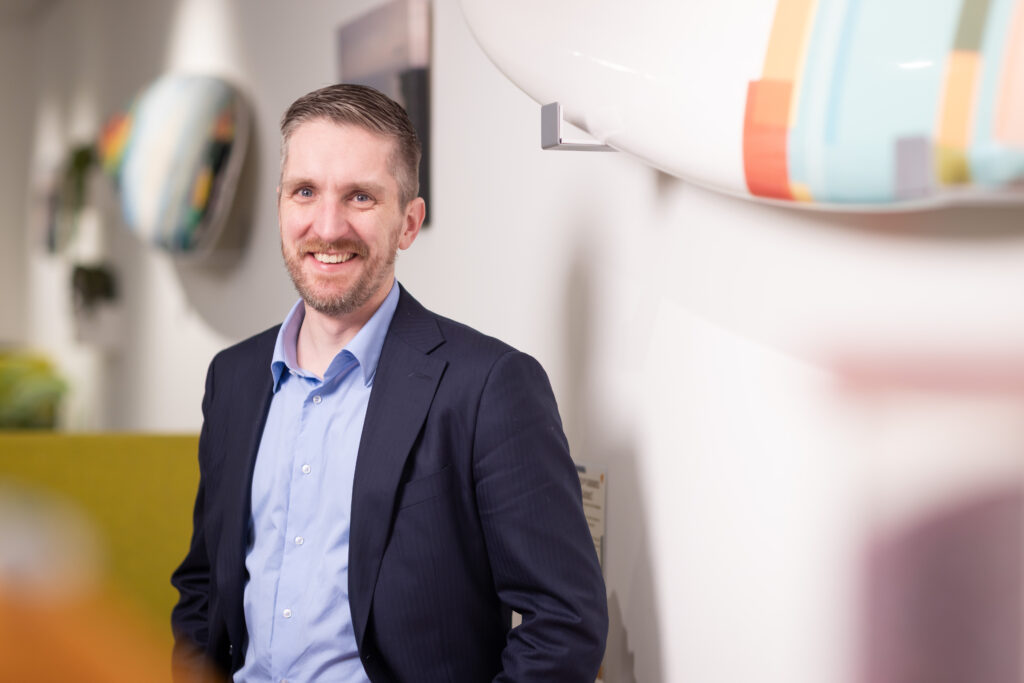
I feel I almost fell into medicine, but I definitely fell into psychiatry.

Dr Hoath grew up in suburban Rockingham along with his younger sister, who is now a nurse. The family is still close, and his friends from those days are still mates.

“I was pretty lucky to have an awesome little group of friends whom I spend my spare time with even today,” he says. “You can have any cliché that you like about Rockingham, but it does make it easier to have a good bunch of friends to help you survive growing up, probably anywhere. We had a pretty good childhood. A nice family and good mates. And we still look after each other.”

He went to Warnbro Community High School, the only one in the area at the time between Rockingham and Mandurah, which had more than 2,000 students.

“One of the deputy principals there, Mark Brooks, was a bit of a legend and probably the reason I got into uni in the first place,” he recalls. “He helped me out with an application for a scholarship.”

A school trip to UWA, especially a visit to the anatomy lab, inspired him to pursue studies in science or human biology.

“In Year 12, I applied for medicine. I’d convinced myself that’s what I wanted to do, but I also applied for nursing and physio,” he says. “I got the bug for doing something health related. Certainly not what I had thought I was going to do.” 

While doing medicine at UWA, he was at one point “dead set keen” on being an anaesthetist, and later was equally keen on being a surgeon, but his surgical rotation ended that thought. “It just wasn’t for me,” he recalls.

The very next rotation was psychiatry.

“I feel I almost fell into medicine, and I’m very, very grateful that I did, but I definitely fell into psychiatry,” he says, “because it was really just a couple of good experiences and a couple of good mentors. And I thought, ‘This is not at all what I was expecting and I’m really enjoying this’. Then I tried to find more experiences in psychiatry, and I did my elective in psychiatry and really loved that as well.”

Kyle had arranged to do his elective in 2009, the year he was getting married, with highly respected UWA psychiatrist Johann Claassen, one of his early mentors. But Dr Claassen, at 47, died unexpectedly from a heart attack while out running. 

“He died leaving behind a family and it was a huge blow to our community back then,” Dr Hoath says. “He was one of my early mentors and I’d been leaning on him a lot to learn about psychiatry. So I felt his loss pretty deeply and for a time I was adrift.

“But Professor Sean Hood (Head of School) stepped in and saved me. He picked up what Johann Claassen had been doing for me, and he took me under his wing to complete my elective.

“At that point, I couldn’t wait to finish med school and be a psychiatrist. I applied for psychiatry training halfway through my internship and got in as a PTY2, so I managed to get into psychiatry very quickly.”

Dr Hoath interned at Fremantle Hospital in 2011 and did the first six months of psychiatry training there as well. He then spent about three years on home territory working for Rockingham Mental Health Service with Canadian-born Dr Gordon Shymko, who became another important mentor.

We don’t need to reinvent the wheel every time we want to solve a problem in our health system.

“I went on to do little bits at Fiona Stanley, the Marian Centre, St John of God Subiaco, and a few other places,” he says, “and then I graduated to become a specialist. 

“In 2018, I started as a consultant and went back to work for Gordon Shymko doing a couple of days a week at Rockingham and a couple of days up at Joondalup on the Early Episode Psychosis team for Headspace. Gordon was the clinical director of both those services at opposite ends of the metro area. I was still living in Rockingham, so the drive to Joondalup was pretty interesting as my first consultant job. I got through lots of audio books and podcasts!”

After that first year behind the wheel, Dr Hoath started a practice in Subiaco called Salvado with a group of other private psychiatrists.

“Not long after that we started a software company called Oqea,” he explains, “with dreams, I guess, of changing the world and changing the way psychiatry is done using some modern technology approaches. Over time, the clinic and the software company have merged, so we have a company that is part med tech and software development and part multidisciplinary clinic with psychologists, psychiatrists and GPs. 

“And that’s what I do as a day job now. I’m the Chief Medical Officer and spend two days doing the executive work, planning, research, stakeholder engagement, and two or three days a week seeing patients privately at Oqea.”

Dr Hoath’s special areas of interest in clinical practice have been ADHD, sports psychiatry, and transcranial magnetic stimulation (TMS) – a non-invasive and pain-free treatment for depression first developed in the 1980s.  

“It’s only been heavily used in Australia for probably 10 years and I believe Medicare has been covering it for the last five years. So it’s relatively new, but incredibly safe, and that’s one of the things we love about it,” Dr Hoath says.

“It was something pretty new that appealed to me as I was becoming a consultant, maybe the timing was good. But I loved the practical hands-on interventionalist style of psychiatry as well, and I spent a lot of time doing TMS early in my career.”

Based on his long experience with TMS, Dr Hoath gets invited to teach people how to use it.

FACT BOX

  • Dr Hoath has been an AMA member since he was at medical school. He was elected to Council in 2019 and joined the Board in 2023. He became Vice-President in 2024. At 38, he is the youngest President of the AMA (WA).
  • He spends most of his time away from medicine with his family – his wife Lauren, a primary school teacher, and their daughters, Charlotte (12) and Zoe (10).
  • His hobbies include tennis, running, basketball, hockey and reading.

“It’s a very small part of what I do, but I’ve been to the Philippines and to Vietnam, and I’m going to Dubai later this year to run courses,” he says. “I also run a two-day course at UWA twice a year, one of the very few that are accredited in Australia, with Professor Jenny Rodger who works at Perron Institute.”

Oqea develops and sells Responsible AI (RAI) tools, which can automate some of the process of report writing or diagnostic assistance and provide more continuity and connectiveness between patients and their health team.

“We do a lot of work with our software, making sure we connect GPs, psychologists, psychiatrists and patients, so trying not to have people needing to retell their stories, or the information being lost and they’re having to start from square one,” he explains. “We’re trying to create solutions that allow for more seamless care, so that if someone’s not available, someone else is, and there’s a continuity there. So the patient feels everybody is on their side and they have some control.”

Dr Hoath has been quoted as saying that psychiatry is “a unique blend of science, psychology, philosophy and art”.

“I’m sure somebody smarter than me came up with that, and I’ve just remembered it from somewhere!” he laughs. 

“Like a lot of medicine, whether it’s pattern recognition, or I wouldn’t want to say ‘trust your gut’, sometimes we make little tweaks or changes to medications. And at the beginning it’s very formulaic and scientific and follows best practice and best evidence, but sometimes the subtle small things we do are more on that artistic side,” he explains. 

“I guess the experience or the sum of experience allows us to make a judgement call that’s slightly outside of the box, not wild. But you’d be surprised how something very little that is hard to put into a treatment pathway can have a big impact on outcomes.

“And from a philosophical point of view, I’m a psychiatrist, but I’m a doctor first. And a lot of what I do is very medical – dealing with medication, diagnosis and the interactions of those things. But patients don’t see the world like that when they come to a psychiatrist’s office. They don’t necessarily understand the difference between a psychiatrist, a psychologist, a psychotherapist, etc, I’m down for that!

“So, you do have that therapy role, that sort of empathic side. In general practice and psychiatry, you really see that highlighted. It becomes a lot about people and their life experiences or their views of the world, heavily influenced by how they were raised and how they want to approach treatment. Maybe they don’t want medication, or maybe they struggle with the idea of being on medication for something like depression. And it does start sometimes to sit into the realms of the philosophical – because it’s the stigma that society perpetuates, and influences our way of thinking or seeing the world, or of judging ourselves or interacting with others.” 

At what point do we say, ‘Enough is enough’? I think we’re past that point.

In a ‘Meet the Councillor’ profile in Medicus last year, Dr Hoath was asked what his priority issue would be if he was Minister for Health.

His response was: “The first issue I would tackle is improving our mental health services. I don’t profess to have the answers, and I know many have tried, but I strongly believe we are at crisis point….”

That crisis, he says, had been forecast by Gordon Shymko, based on his professional experience in Canada, when Dr Hoath was working with him as a registrar.

“He had these frustrations of having seen the problems of short-sighted bureaucratic or political decisions that didn’t appreciate the longer-term need of finding the same solutions that other countries and other health services have over time managed to achieve to some degree or other,” he recalls. “We seem to have such a knee-jerk ‘we want to make the mistake ourselves’ kind of pattern in policymaking. 

“I remember Gordon being quite frustrated with that, and saying if you look at the positive impact that partnering with NGOs to provide better wraparound services for these young kids with early onset psychosis has; you also see this constant erosion of any funding to maintain those kinds of programs. And, I guess that thought stayed with me. If we keep going down this path, all we’re going to do is amplify the problem; all we’re doing is shifting the problem elsewhere; and it will grow and have more and more impact. 

“It is, I think, what you see when you look around now. There are so many little boiling pots of subsections of our health system that are all at breaking point independently, because they’ve been neglected or underfunded; or with no proper investment for the future; or planning for what it would be like if our population was to double.. 

“Not just in psychiatry, but throughout the health sector, and when individual specialties start to come under such pressure, I don’t know why we need to act surprised when ramping numbers go up; or when doctor health surveys tell us our junior doctors are burnt out and questioning whether they’ll stay in the profession. These are more the end-result outcomes that we’re seeing now.”

Dr Hoath says he doesn’t have all the answers, but he has some ideas in line with Gordon Shymko’s thinking.

“No one’s got it perfect, but it doesn’t mean we can’t look at other states of Australia, other western European countries, or any other country around the world to see who does what well,” he suggests. “Who does mental health well? Who does surgical waitlist well? Who does ED well? Who’s got a good system for GPs, pharmacists and nurse practitioners to all get along? 

“No one’s probably got it all nailed down, but there are places that do some of this well. A good example is the way Canada manages ADHD care across a whole host of professions, including GPs, not just psychiatrists. 

“We think we’re cutting edge and breaking new ground doing that in WA and NSW, but it’s been the status quo in Canada for a long time, and it’s worked well. We should be learning the lessons of what they went through, rather than trying to reinvent the wheel. And yet WA and NSW are now going about it in a different way. 

“We had Senate inquiries saying we should align more as states, and yet the very first thing they do from a policy point of view on ADHD reforms is to tackle it in different ways.

“We definitely need to look at ways of doing things differently, but that doesn’t mean we have to come up with all ideas on our own. Don’t get me wrong, there’s a balance. Thought leadership is important and no one does anything perfectly, but we don’t need to reinvent the wheel every time we want to solve a problem in our health system.” 

Start typing and press Enter to search