



Jonathan’s Enthusiasm for his work is infectious
When did you first know you wanted to be a doctor?
My first degree was a Bachelor of Science in microbiology and molecular genetics. I was attracted to this area due to a fascination with biological science. I’ve always loved microscopes, so molecular biology and pathogens became my strong interest throughout university. After completing my degree, an opportunity with the new Notre Dame University Medical School came up, and fortunately they accepted me. I knew on the first day at medical school that it’s what I wanted to do.
Why did you join the AMA (WA) Council?
I’ve been an AMA member since I became an intern. I’ve always been grateful for the AMA’s advocacy, both for doctors and the health needs of the general population. However, I never participated to any great extent until I was requested to by the current president, Dr Michael Page, who (as we all know) started out as a consultant at Western Diagnostic Pathology. And Dr Rebecca Wood, who was working in ICU at the time, collared me. It was during the start of COVID-19, and they convinced me I might be useful – so I agreed to be co-opted.
What outcomes have you seen as a result of your council position?
I think I’ve been able to quietly advocate for many issues related to infectious diseases, pathology (particularly clinical microbiology) and uniquely for those of us working in private and private/public partnership hospitals.
I’m always happy to contribute to discussions broadly, and find myself surprised at the number of issues raised within council that affect my practice.
My biggest achievement was participating in the working group for Pharmacy UTI prescribing with Dr Ramya Raman. While we couldn’t have the program halted or urine testing made mandatory, we did achieve significant restrictions to the program which will hopefully minimise the potential harm to our patients
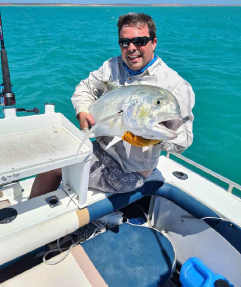
Jonathan on his boat: Proudly displaying his catch of the day.
Why did you choose pathology?
The people – I know it sounds weird, but I love working in laboratories. Whether it’s the quirky histopathologists who show me their interesting cases, or the mysterious chemical pathologists who ultimately end up running the show. The haematologists are always very knowledgeable, helpful, and up for a chat (at least I think they’re happy to talk).
Obviously clinical microbiologists are the cleverest, wittiest and most normal doctors in the laboratory – so there’s that as well! There are others in genetics, forensics and immunology (probably more) who are also just as passionate about their disciplines.
The tests – there’s nothing betting than getting into the nuts and bolts of pathology testing. Implementing new tests, giving advice on interpretation, and chatting to my colleagues about a result. I hope the insights I give late at night to my junior colleagues are as informative as they are fun. Everyone loves pathology tests, that’s why you all order so many of them, right?
Then, there are the scientists and technicians who are the hardworking, faceless voices in that mysterious building – they do all that hard work so passionately to produce the right result, on the right patient, and in a reasonable amount of time. They all have the same desire for patients to benefit as we do (make sure you tell them how important they are!).
Where does your interest in infectious diseases come from?
My interest in infectious diseases is simple. In many cases (not all) infections get treated, cured, and the patient may never need to see me again. One that fascinates me the most is the Staphylococcus aureus bacteraemia – despite being one of the most common reasons for an infectious disease consultation. Every patient is different, fortunately most of them do pretty well.
What would you tell a young doctor looking to specialise in pathology?
Get broad general medical and surgical experience before embarking on the journey. Pathology is very extensive and, in many cases, has dual pathways with the reciprocal physician specialty which requires you to complete the RACP BPT program and advance training. These pathways are not for everyone, but I think I benefited from doing combination physician and pathology training.
Fill in your request forms properly! If you can’t read it, we can’t. If you don’t know what to request, don’t just send it – ask the pathologist, or check the diagnostic test directory for your laboratory.
Do you have any particular heroes or mentors who guided your path?
Probably more of an anti-hero – House was an infectious disease physician! I loved my time as a registrar at Freo, RPH and FSH, and I remain indebted to the two public microbiology depts in Perth. I do have to shout out to Duncan McLellan for sorting out my first consultant job/s.
What’s the first issue you would tackle if you were WA Minister for Health?
A universal medication formulary across the country for any Medicare-eligible patient, regardless of which hospital they are admitted to or outpatient setting they are seen in – similar to Pharmac (NZ). Private patients cannot access funded medication in many cases unless it is on the PBS. In infectious diseases, this leads to high out-of-pocket costs and, in some cases, determines the choice of some medications. This is an issue for so many other disciplines. High-cost and non-PBS medications get funded in state-run public hospitals, but not in the community or private hospitals.