




Dark Pines

Dr Rob Lethbridge
Like a lot of slightly pretentious 20-year-olds who grew up watching Frasier (I’m sure there are dozens of us), I loved the movie Sideways, Alexander Payne’s exploration of fragility, friendship and wine. It was a movie that – unintentionally – destroyed the reputation of poor, innocent (and delicious!) Merlot, while holding Pinot Noir’s ‘heartbreak grape’ reputation as an attribute to lionise. Twenty-one years later, the allure of Pinot Noir is as strong as ever, and its temperament just as unpredictable.
Pinot Noir is a grape that rewards, and often requires, a high degree of attention. Thin-skinned and growing in tight pine-cone shaped bunches, there is a high susceptibility to about every viticultural hazard there is. It’s a grape that favours long, cool growing seasons often moderated by nearby large bodies of water.
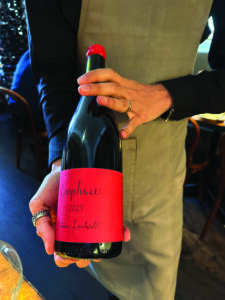
Pinot is always a great pair with food. This one went with a duck breast and beetroot at Balthazar for a classic combination.
Burgundy is the spiritual home of Pinot Noir, and French Pinot Noir of particular quality is likely to come from somewhere within the Côte-d’Or – where each slope, village and latitude exposes different facets of the grape. The wine from Burgundy was a favourite of both Roald Dahl and Emperor Charlemagne, and it’s still a benefit to have a particularly regal bank account if you want to explore the myriad subregions. While there’s plenty of good Burgundy for less, there are estimates that in its most famous vineyards at Domaine de la Romanée-Conti (DRC), each individual grape is worth about $5, with a bottle easily setting you back a cool $20,000!
Luckily, Pinot Noir is now spread around the world, and each brings something of its character to the wine, usually for a less eye-watering price. We may be more familiar with delicious examples from our neighbours in New Zealand, but other New World examples from South Africa, Chile and – of course – Australia provide delicious diversity.
Over the last few months, I’ve had a weirdly intense bunch of pinot tastings. Beginning with Bollinger, from which my wallet is still recovering, into Pinot Palooza, and reaching its zenith at the International Pinot Noir tasting at the State Buildings – it has been a cavalcade of the cool-climate character.
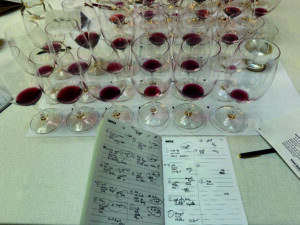
Hard at work… My notes significantly decline in quality as the day goes on.
And through all of that, while Australia does hold its own, one of the best wines I had was from California, with gorgeous texture and balance exceeding the equally priced Burgundies.
What all this tasting showed me is that while ‘classical’ Burgundy is a light ruby colour, bursting with cherries, raspberries and tea, that’s a small slice of what it can do. To pigeon-hole Pinot Noir is to do a disservice to one of its most interesting features: its diversity.
From bright bold plums and black fruit with surprising opacity through to dainty, leafy green tea and chamomile, age can reveal elements of crushed leaves of the forest floor and porcini mushrooms. And that’s without even exploring its role in Champagne!
It is a grape that constantly excites, intrigues, and allows terroir and location to shine through. And despite all the tasting, it’s a tiny glimpse of the complexity that’s out there, and I’m still hungry to explore it more.