I am aware Dry January is ‘a thing’ people do; and I fear that as a writer in a medical journal it’s important that I emphasise this is a good idea with many positive benefits, both physically and mentally. My main objection is that at least Dry July rhymes. I don’t like that someone has tried to co-opt Dry July’s lovely rhythm and awkwardly mutate it to Dry January’s horrible jarring dissonance. It being six months later and starting with a ‘J’ is not good enough!
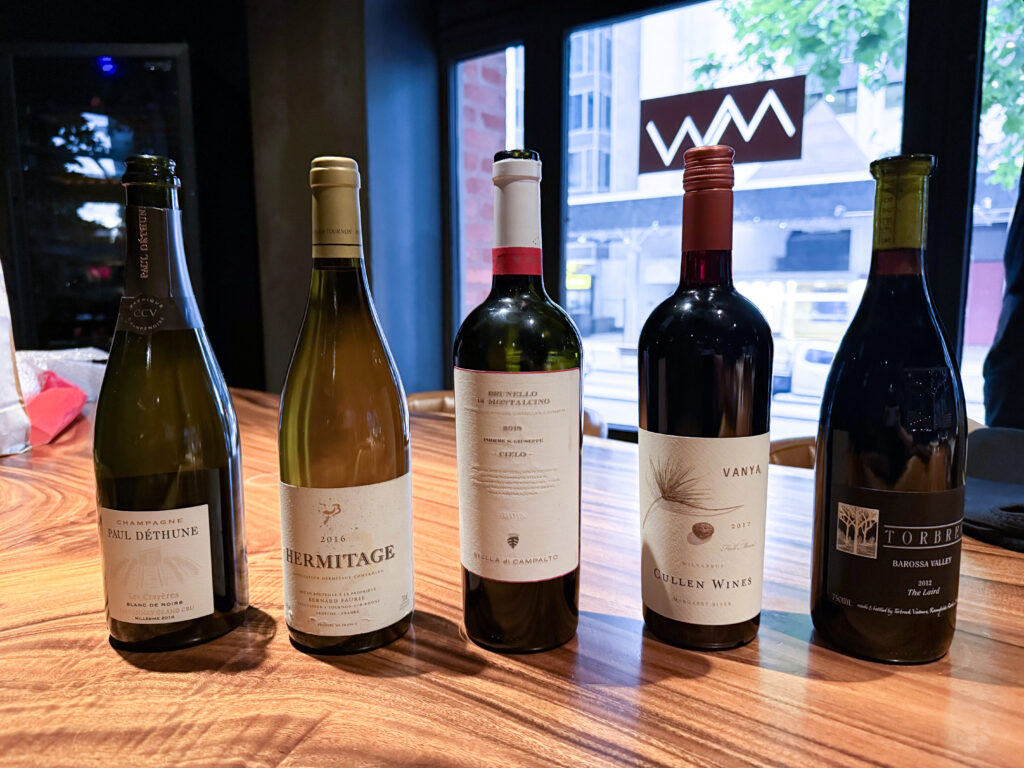
Due to my linguistic concerns, I’ve never started the year with temperance. This was doubly true this year when a good friend – and sommelier – happened to be leaving WA and needed a goodbye dinner. Each of the night’s wines was an absolute ‘banger’, so I thought it would be fun to explore why they were unique and what they brought to the table.
Paul Déthune Blanc de Noirs – Les Crayères
One of the best bottles of Champagne I’ve had all year, this is a 100% Pinot Noir (hence ‘white from black’) from a legendary Grand Cru vineyard in Ambonnay. The Déthune family have been tending to the vines on this site since the 1600s, and making their own wines since 1890. It poured pale gold and tasted of red apple, caramel and strawberries with great citrus-y acidity.
Bernard Faurie Hermitage Blanc
Bernard Faurie is also from a wine ‘lineage’, the fifth generation to farm the slopes of the hill of Hermitage in the Northern Rhone. While the bulk of his 100-year-old vines grow Syrah (Shiraz), a small fraction is set aside for this hard-to-get 100% Marsanne. Only around 800 bottles are made each year, with whole bunches pressed and naturally fermented. Concentrated pear, white nectarine, and a certain ‘density’ of texture and flavour made this a very-easy-to-accidentally-pour-too-much drop.
Stella di Campalto – Brunello di Montalcino 2018 ‘Cielo’
Stella di Campalto is one of the most sought-after producers in Brunello. The family farm was abandoned in the 1940s, but in 1990 she replanted the 13-acre hillside exclusively with Sangiovese vines. She now uses organic and biodynamic principles (which I’m always a little cynical about) to produce a wine of stunning quality. An intoxicating sweet nose of flowers and wild herbs, it was a wine that evolved over the night, revealing red and dark cherries and berries, as well as baking spices and liquorice.
Cullen ‘Vanya’ Flower Day 2017
Needing no introduction, the Vanya is now Cullen’s flagship Cabernet Sauvignon from a particularly good vintage. WA’s trailblazer when it comes to biodynamics, the grapes were picked on 3 April 2017 (a Flower Day) and spent 107 days in terracotta amphorae. A few reviews describe it as “fleshy”, which seems right – it’s densely packed with juicy dark fruit, crushed violets and cedar, with a velvety texture but still unmistakably ‘Wilyabrup’.
Torbreck ‘The Laird’ 2012
An absolutely massive punch in the face of intense fruit, this 100% Shiraz from a special dry-grown single vineyard in Barossa is even harder to get than their famed Run Rig. Opulent and verging on port-like, it has layers of cherries, spice, earthiness and leather. Somehow, it manages to retain an incredible balance despite the alcohol, and shows the level of complexity Barossa is capable of.
Yves Cuilleron Condrieu ‘Les Chaillets’ 2023
An amazing surprise brought in by someone who quite literally happened to be nearby while we were eating dinner and wanted to join, this stunning Viognier was an amazing finish – with a sweet nose of apricots, rose, quince and honey but a restrained, slightly saline palate.
In summary, a pretty good night, and a great start to 2026! Maybe I’ll be drier in July. At least that rhymes.