




A big YES to Henry’s success

The AMA (WA)’s Dr YES program sends out teams of volunteer medical students to high schools to help students make informed health choices in risky situations. The program is well set for the future, having had one of its most successful years under the leadership of Henry Pemberton, writes Martin Saxon.
For medical student Henry Pemberton who was juggling course studies and other personal and community commitments, it came down to an issue of unfinished business. And he meant business.
Henry started as a volunteer with the Dr YES program in 2019 when he began his medical studies at the University of WA. After developing his skill set in running in-school sessions, he was made a program coordinator in 2021, which was supposed to be a one-term appointment.
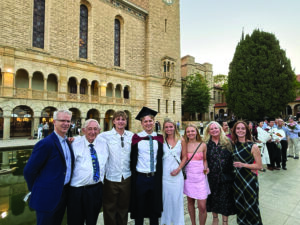
Graduation day: Henry’s father Richard Pemberton, grandfather Colin Binns, brother Oliver, Henry, siblings Annabel and Eloise, mother Sarah Binns, and Henry’s girlfriend Anna Gray (also a doctor).
“Most people finish after that,” Henry said, “but I stuck with volunteering. I always felt like I had unfinished business with the program, so I was very grateful for the opportunity to return as the team leader for 2024 and make my mark with the achievements our team made in resuming regular volunteer training, working with outside organisations to upskill them, and delivering a larger volunteer cohort as well.”
Henry, now 24, said the first step towards success last year was to actively market the program and “put in the hard yards” to recruit volunteers from among medical students at UWA, Notre Dame and Curtin University.
“So, we started with a large group of people who were very excited and keen for Dr YES, but didn’t yet have the skills,” Henry recalled. “Then we sort of did some self-reflection on how to continue retaining these people.
“We kept coming back to the fact that these rural trips we run are mutually beneficial. We visit these schools we believe really need the training we can offer, and it’s a fantastic way to encourage new volunteers to come. And because they’re doing four sessions a day rather than three or four sessions over an entire week, they develop their skills in presenting to students much faster. So it’s a great way to upskill the volunteers and drive new volunteers, while also seeing those areas that perhaps need our education even more.”
Medical students working on the program start as a ‘green dot’ volunteer on the three focused sessions that Dr YES runs. As volunteers become more confident and comfortable delivering parts of the sessions on their own, they can graduate, with a sign-off from a coordinator, to becoming a ‘red dot’.
“That means you’re qualified to run the session by yourself and teach new volunteers as well,” Henry said.
Under the team leader, a role established three years ago, is a team of seven coordinators who manage the day-to-day operations of Dr YES.
“They meet regularly with the team leader, the person who has the top-down, bird’s-eye view of the program and how we’re tracking along, and who liaises with the AMA (WA) more broadly and with the Department of Health as well,” Henry explained.
Henry says it’s hard to say what’s he’s most proud of that Dr YES achieved in 2024, one of the most successful years in the program’s history.
“One thing was as part of the contract with the Department of Health, we have several performance indicators. Since the post-COVID period, it’s been difficult to tick off every one of those things. For the first time in six or seven years, we reached all those performance indicators last year.
“We achieved that because we had regular volunteer training. We heard from a PhD student in neurodiversity; we had a workshop run by the WA AIDS Council; we had a new rural trip to the Geraldton and Kalbarri area; and we had a lot more volunteers graduating to the ‘red dot’ status.”
Dr YES runs three sessions in the high-school health education program: on sexual health; alcohol and other drugs; and mental health.
“Sexual health focuses on STIs, consent, safe sex and pornography,” Henry explained.
“Alcohol and other drugs education largely focuses on alcohol and includes harm-minimisation methods for drug use.
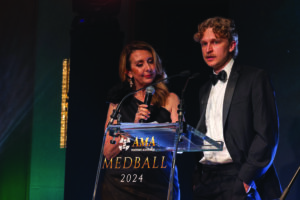
Henry speaking at MEDBALL 2024, with Tina Altieri.
“Mental health is a bit more of a free-flowing session depending on where the group wants to go, but usually focuses on preventative measures people can take to maintain their mental health, and what to do if you start noticing a friend who’s having a tough time.”
The format of the Dr YES presentations depends on what the school wants.
“We usually start with a general address to a few classrooms of students and then we break up into these small group sessions, usually one ‘red dot’ for a group of seven to 15 students,” Henry explained.
“We have a rubric of how we like to run a session and the content we have available, but we always really value the feedback students give us in real time during the session. We’ll always steer sessions towards topics that students indicate they want to know about.
“That’s part of the model of Dr YES. These people delivering sessions are barely out of high school themselves, so it’s quite relatable. It’s more like having a conversation with these students.”
When asked how Henry, now doing his residency at Royal Perth Hospital, managed to juggle his intense medical studies, his leadership of Dr YES, and his other commitments last year, his reply was: “With careful time management, I think.”
“My priority was to do well in my academic course, but also to continue to volunteer.
“Part of what helped is I developed so many rich friendships with other people in the program too, so it was a way to give back, but also to hang out with my friends at the same time.”
Shannon Morgan, the team leader for 2025, who became a Dr YES volunteer in 2021 and a coordinator in 2023, is full of praise for Henry’s leadership.
“Henry’s genuine passion for the program is at the forefront of all he does,” Shannon said, “This has made him an excellent leader, advocate, and motivator for the coordinators who manage the day-to-day operations of Dr YES.
“Henry’s selflessness also extends beyond his time as team leader, as he has laid the foundations for new ways Dr YES can improve and continue to grow in the years to come.
“Thanks to Henry’s expert leadership, Dr YES in 2024 conducted more sessions, and was able to engage with a greater number of young people than in previous years.
“Now transitioning into the role of team leader, I am truly looking forward to what the coordinators and I can achieve this year to continue the growth of this valuable program.”
Run by the AMA (WA) Foundation, the Dr YES initiative has been operating since 1996.