



It’s ‘genetic roulette’ and Nigel Laing isn’t playing

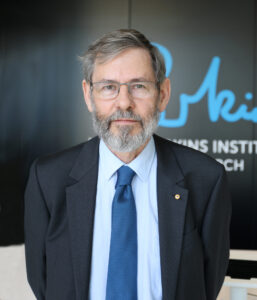
Emeritus Professor Nigel Laing at the Harry Perkins Institute.
Geneticist Nigel Laing has been working towards this moment for more than 30 years. And a positive decision can’t come soon enough, though he knows these things don’t happen overnight.
“A wise person from the east reminded me that it took 15 years from the first trial of bowel cancer screening for the program to be implemented into practice,” he says.
“That could mean that it will be 2039 before reproductive carrier screening is implemented as a national program. Personally, I could not stand that, because every day, every week, every month, every year that passes, more Australian kids will have these awful conditions, which their parents could have avoided if the choice was available.”
The Perkins research scientist was a co-lead in the groundbreaking Mackenzie’s Mission study that found almost one in 50 of the 9,107 couples who were screened had an increased risk of passing on a serious or fatal recessive genetic disease to their children.
Nearly 90% of the at-risk couples had no family history of the condition and had no idea that they might give birth to an affected baby, which is why Professor Laing has dubbed it “playing genetic roulette”.
The results of the Mackenzie’s Mission study were published in November in the New England Journal of Medicine and the magazine’s editorial, written by a Netherlands expert in the field, said that the overall findings would ‘inform a global research agenda for years to come’.
The editorial went on to say: “For Australia, the question is whether expanded carrier screening will become accessible at no cost to those who opt to undergo screening.”
Currently, reproductive genetic carrier screening is only available for three conditions on the Medicare Benefits Schedule: spinal muscular atrophy (SMA), cystic fibrosis and fragile X syndrome. Screening for these conditions went on the Schedule in November 2023.
Emeritus Prof Laing AO has been regularly monitoring how many couples have accessed this government-funded testing since then, and he says the uptake of the three-disease screening has been amazing.
“I keep track of the monthly usage of the Medicare item number, and it’s now running at the equivalent of 120,000 to 130,000 couples a year. It’s huge,” he says.
The federal Department of Health, Australian Genomics, and expert working groups have been discussing how best to set up an expanded genetic carrier screening program for about 18 months. A draft proposal for implementation is being finalised and it is due to be submitted to the department by 30 June this year. One question, obviously, is the cost of establishing a taxpayer-funded national program. Mackenzie’s Mission cost $20 million, financed by the federal Government’s Medical Research Future Fund through Australian Genomics, but Prof Laing points out that the research project did a lot more than just testing the couples who signed on.
“The number of publications that are coming out of Mackenzie’s Mission cover all sorts of different aspects: the genetic counselling, the ethics, the implementation, the lab work, and so on. There was a lot more expense in Mackenzie’s Mission than if you’re actually running the program,” he says.
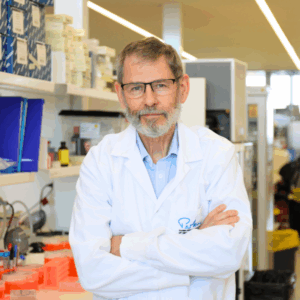
Emeritus Professor Nigel Laing in the lab.
“If you look at the three-disease program, that I think is running at somewhere around $50 million a year, but now you’ll be looking at a thousand genes and you’ll pick up five times as many high-chance couples.
“If we’re talking about all those couples who are having the three-disease screen, which is a relatively simple test, moving over to the expanded screening – and why wouldn’t you if it became available – one might anticipate 150,000 couples, so then you have a lot of data to generate, a lot of sequencing to do. The infrastructure that you have to put in place is quite large.”
Prof Laing says Mackenzie’s Mission demonstrated that screening the couples together, rather than individually, reduced the number of genetic counsellors required.
“When you do a thousand genes, basically almost every individual is a carrier of something,” he explains. “We did it by couples, so we analysed the male and female at the same time. That cuts down enormously on the workload because we identified one in 50 couples at a high chance instead of more than 90% of individuals, so you don’t need as much genetic counselling if you do it the couples way.”
Prof Laing says gene sequencing for the Mackenzie’s Mission study was handled by different laboratories across the country, which meant the project was not derailed by the COVID pandemic.
“We had just started to recruit couples when COVID hit,” he recalls.
“There were three labs doing the testing: one in Sydney, one in Melbourne, and the one here at PathWest. The two interstate labs, especially the one in Melbourne, were so heavily hit by COVID that they had to reduce or stop taking in samples for months; whereas PathWest, with WA having shut its borders, could continue.”