While the World Health Organisation (WHO) set global targets for 2030, Australia has set even more ambitious goals:
- 90% HPV vaccination target for boys and girls.
- 70% screening target to five-yearly participation for eligible 25 to 74-year-olds, rather than just twice in a lifetime.
- 95% treatment target to ensure equitable access and eliminate cervical cancer for all.
In 2018, cervical cancer was categorised as the fourth most common cancer prevailing among women worldwide. Its incidence in pregnancy is low, 3.3 to 26 cases per 100,000 births. In pregnant women, the prevalence of abnormal cervical cytology is low (2 to 7%), like the non-pregnant population. Despite this, cervical cancer is the most common malignancy during pregnancy.
Introduction
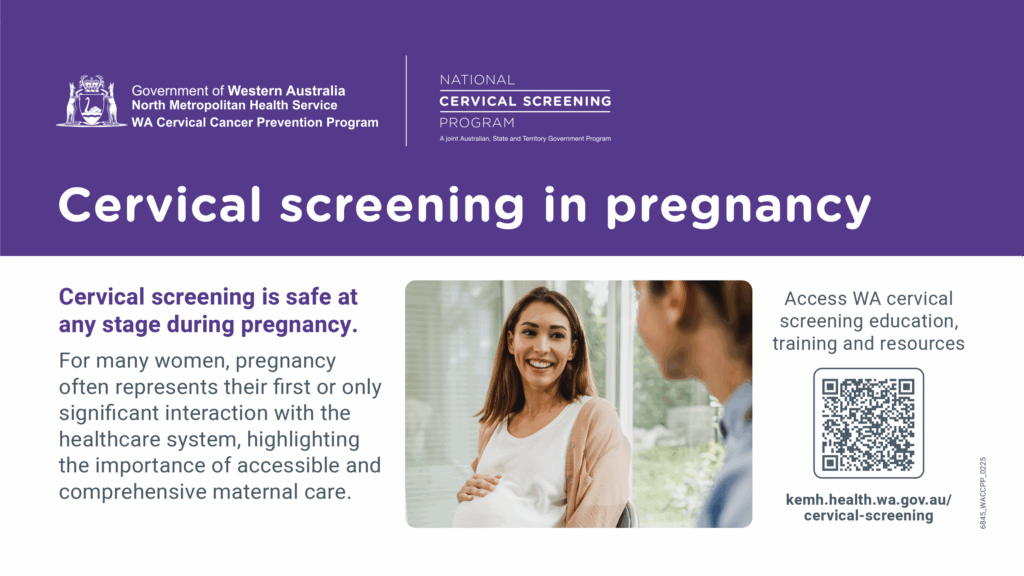
The Cervical Screening Test (CST) is safe during pregnancy provided the correct equipment is used [2025 National Cervical Screening Program (NCSP) clinical guidelines]. Both clinician and self-collected samples are viable options. For many women, pregnancy offers a unique opportunity for healthcare engagement, and it can represent the first or only interaction with the healthcare system. Approximately 1 in 20 women (5%) will have abnormal cervical cytology in pregnancy.
CST in pregnancy
Routine care should include a review of cervical screening history. CST is safe throughout pregnancy, but preferable in the first trimester to allow early detection of cervical dysplasia. Although the transformation zone (TZ) and the squamocolumnar junction (SCJ) are more visible during pregnancy, complete visualisation of all four quadrants is often hindered by pregnancy-related changes. A ‘deep’ sample with a cytobrush or combi-brush is unnecessary and inadvisable because of the risk of bleeding; a broom-type brush should be used instead. Informed consent should be provided regarding discomfort and contact bleeding due to increased vascularity of the cervix.
Clinical evidence has shown that cervical screening, when performed correctly, does not increase the risk of miscarriage or preterm birth, which is reassuring to both practitioners and patients. So it is essential to encourage patients to proceed with their regular cervical screening during pregnancy when it is due.
Managing abnormal results during pregnancy
Management of abnormal results in pregnancy is challenging, particularly high-grade changes. Cervical cancer has a long ‘latent’ stage. If left untreated, it may take 10 years or more for precancerous changes to develop into cancer. Persistent HPV infection in pregnancy can indicate a need for follow-up, including colposcopy, especially with HPV 16 and 18 (detected in 70% of cervical cancers worldwide).
Patients with low-grade cervical intraepithelial neoplasia (CIN) in pregnancy, with expert colposcopy and concordant cytology and histology results, only require one antenatal colposcopy prior to postpartum revaluation. The main indication to biopsy is to exclude invasive disease. If the colposcopic impression concurs with the cytology, it is acceptable to avoid a biopsy. If a biopsy is deemed necessary, brisk bleeding may be encountered.
In recent years, there have been numerous studies pertaining to the outcome and progression of CIN throughout pregnancy, whether they progress (1-3%), persist or regress; also, whether mode of delivery has an impact. There is no clear consensus, but mode of delivery is unlikely to amend the natural progression of CIN. If a vaginal delivery is a feasible option, that should be encouraged.
Although treatment of abnormal results is typically deferred until after delivery, at times there is an urgent clinical need to intervene. Where treatment is deemed necessary, it is crucial to provide patients with clear, evidence-based information about the nature of their results and implications for pregnancy.
Postpartum follow-up and HPV vaccination
Reassuringly, spontaneous regression postpartum has been reported to be in the range of 16.7 to 69.3% with high-grade CIN. Several theories have been proposed. The immunosuppressive effect of sex hormones throughout pregnancy, complete excision of dysplastic epithelium during a biopsy, and disruption of the epithelial integrity during delivery may trigger a local immune response leading to regression.
Conservative management of high-grade CIN is safe during pregnancy, as the rate of persistence is high and the rate of progression is slow. Cautious postpartum evaluation is recommended. Healthcare providers should be aware that, whilst HPV vaccination is not recommended during pregnancy, it is safe and beneficial to administer the vaccine postpartum. The updated vaccination schedule recommends a single-dose schedule for HPV vaccination.
Risk factors and hormonal changes during pregnancy
Increased estrogen levels during pregnancy may cause cervical changes that are benign, but could be mistaken for precancerous changes at colposcopy. Persistent vaginal bleeding or abnormal discharge during pregnancy may be due to non-obstetric causes, warranting further investigation. Clinicians should remain vigilant, ensuring all potential causes of abnormal symptoms are thoroughly explored and addressed.
Conclusion
By adhering to updated guidelines, offering clear patient education, and staying informed about the latest resources and recommendations, we can ensure cervical screening remains an essential component of women’s health, both during pregnancy and beyond. The new 2025 NCSP guidelines will assist health professionals navigate cervical screening during pregnancy, providing evidence-based recommendations to guide their practice.