


Heart to heart

Back in the day, if a heart patient in WA needed a transplant, they had to go to the eastern states and spend months away from home waiting for a donor heart; and then months in recovery after the operation. If they survived.
“There was really an incredible social dislocation for our patients to move to Sydney or Melbourne to await a transplant,” cardiothoracic surgeon and AMA (WA) member Robert Larbalestier recalled. “The patient is probably waiting for a transplant for six months, and then they’re hanging around for three months after, so you’re taking nine months out of your life and your family’s life – and people from WA actually died waiting for a transplant.”
Things needed to change. But part of the justification for establishing a heart transplant program in Perth also underlined the challenges it would face.
“The odds were against us,” Professor Larbalestier said. “The logistics around running a transplant program in WA were rather enormous because of the challenges of being a geographically isolated service, and because of the relatively low volume. We were always going to struggle in terms of the volume, and therefore a lot of pressure to deliver results for people.”
But if anyone was going to make it work, it was Robert Larbalestier. He did his medical degree at Sydney University, finished his cardiothoracic training at Royal North Shore in Sydney, Royal Melbourne and then Royal Perth Hospital (RPH), and completed his post-grad education at Harvard Medical Centre, Brigham and Women’s Hospital, and the Children’s Hospital in Boston. He returned to Australia to take a specialist position at St Vincent’s Hospital. In September 1993, he returned to work at RPH, where he was asked to start a transplant service.

Prof Rob Larbalestier in theatre performing heart surgery.
“I basically set it up based around my experience at, predominantly, St Vincent’s Hospital,” Prof Larbalestier said. “I tried to emulate the structure of St V’s and I also tapped into the experience in the Alfred Hospital, and I got generous support from both institutions.”
The WA heart transplant service was established in November 1994 with just a team of three: Larbalestier, cardiologist Mark Ireland and nurse Donna O’Shannessy. Soon added to the team as a consultant was Dr Gerry O’Driscoll, who began a vigorous and successful research program and soon led the medical side of the service.
“Part of our mantra was that we would give people as good or better results than the east coast, and that we’d contribute to the science and art of transplantation,” Prof Larbalestier said. “From the very outset, we were involved in research. We were always very innovative in terms of technology. That’s what we really built the backbone of the program on.”
Prof Larbalestier paid special tribute to Prof O’Driscoll for his immense contribution to the program.
“He rapidly became recognised as a leader in heart transplantation, both clinically and for his research,” he said. “The excellent results our program had in the early years were in no small part driven by Gerry’s incredible dedication to the patients and his fantastic skills as a doctor.”
Over the first few months of the program, the team had recruited a cohort of four or five patients who needed a new heart, and then waited until they found what they thought was the best donor and recipient match.
On 20 February 1995, on his 35th birthday, Rodney Western from Esperance became the first patient to undergo a heart transplant in WA.
Prof Larbalestier recalls there was some “nervous anxiety” going into theatre.
“Because you never, never know,” he said. “We still never, never know when you sew in a heart whether it’s going to work straightaway or not, so there’s all those risks around that.
“When you retrieve a heart from a donor, it’s working normally. But you take it out, put it in an esky or whichever way you’re going to transport it; and until you sew it into someone, you never know what it’s going to do.
“Sometimes they start working straightaway, sometimes they take a day or two. The majority will kick in and work well sometimes after an hour, or sometimes three to four hours of rest and support on the heart-lung machine. Again, there are those unknowns.”
The operation was a success and Mr Western is still alive today.

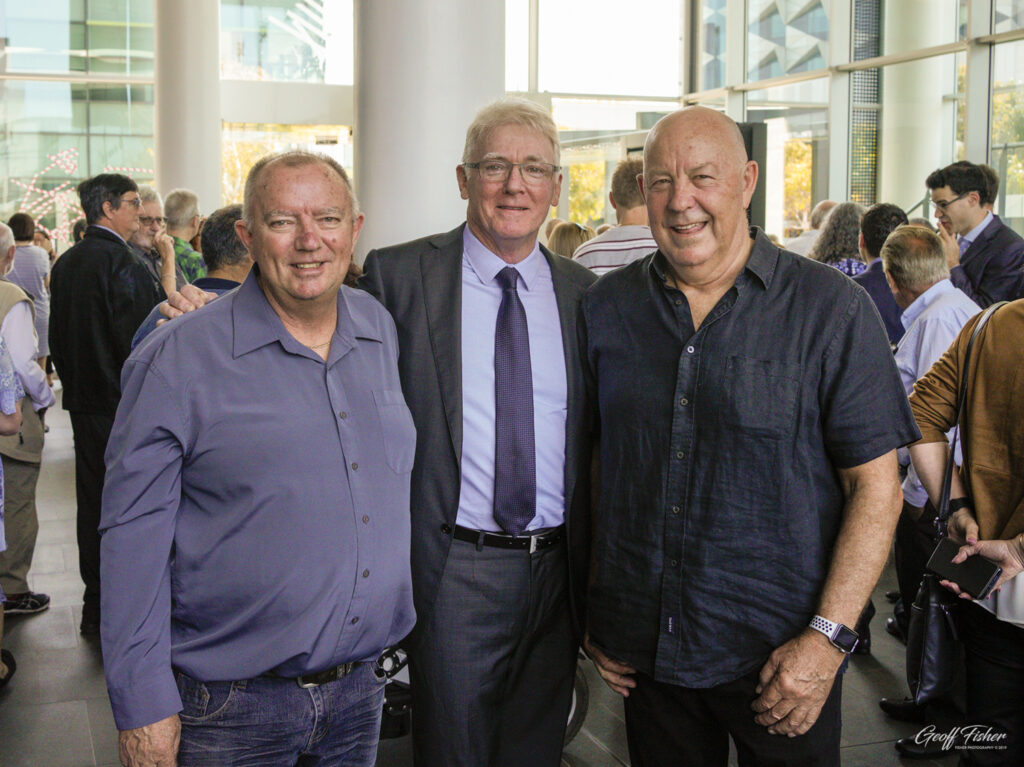
Prof Rob Larbalestier, Rodney Western and Clare Fazackerley.
A cardiac transplant Nurse Practitioner, Clare has been
caring for Rod since his transplant 30 years ago. Picture: FSH
“Rod’s lived a full life,” Prof Larbalestier said. “He’s been a very good patient. He’s looked after his health and taken his medication religiously and stuck to the program we’ve given him, and he’s reaped the benefits of all that. He’s been lucky that his body has tolerated the transplant well.”
After the success of the first transplant, the team started to “push the envelope”.
“For the second transplant, I flew to Adelaide to pick up the donor heart,” Prof Larbalestier recalled. “I think 40% of our donors in the first few years came from Adelaide, so that’s really pushing the envelope back in that era. Adelaide is five and a half hours ‘out of body’ time for the organs. If you read the literature, anything over three hours is running a risk.”
Prof Larbalestier explained that South Australia doesn’t have its own heart and lung transplant program and therefore offers donor organs on a rotation basis to transplant centres around the country.
“It’s Australia’s best organ donor state,” he said, “so we nominated from the outset to be part of that allocation program.”
Ten years after WA’s first heart transplant, Prof Larbalestier performed WA’s first lung transplant. There have been more than 500 heart and lung transplants since the service began.
In 2018, a very close friend, Geoff Fisher, needed a new heart and was brought into the transplant program. Prof Larbalestier decided to lead the successful operation.
“It’s very complicated,” he said. “Perth’s a small town, and I’ve operated on a number of people I know very well, some closer than others. I treat everyone equally, in the operating room or elsewhere. I treat them the same no matter who they are.
“You have to stick to your principles, and the principle is you treat everyone the same way. As soon as you start changing your decision process because of a personal interest, then you’ll make an error.
“In terms of Geoff Fisher’s eligibility for transplant, we had a multidisciplinary team where everyone on the team had their say about whether they thought someone should or shouldn’t be transplanted, and there was unanimous support for Geoff to go down that pathway. I basically sat in silence for those discussions and people were free to voice their opinions about all those issues.”